
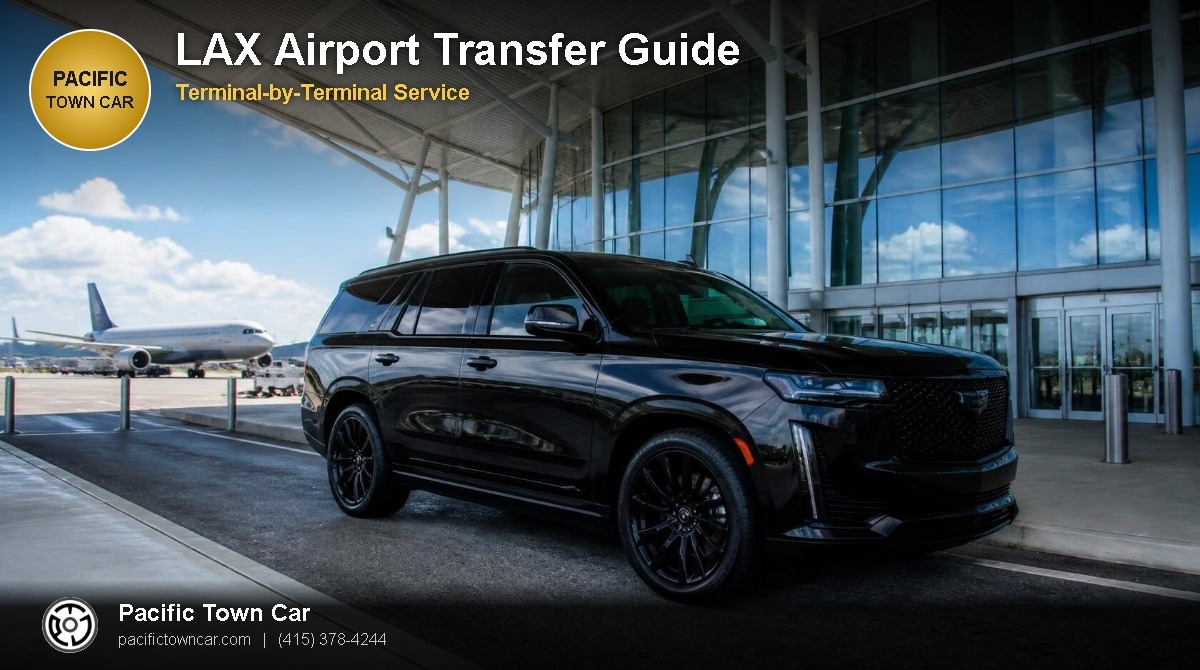
Los Angeles International Airport moves more than 88 million passengers a year through nine separate terminals, and if you have ever stood on a crowded curb trying to figure out which door leads to which carrier, you already know why so many travelers now book LAX luxury SUV service instead of gambling on rideshare lines and shuttle buses. Unlike a generic airport overview, this guide walks you through LAX terminal by terminal — Southwest’s home base, the Delta complex, the international terminal, and the American Airlines cluster — and explains exactly where a private chauffeur can (and cannot) pick you up at each one. Whether you are flying into Tom Bradley International Terminal from Tokyo or catching a short hop out of Terminal 1, knowing the layout in advance turns a stressful arrival into a smooth, predictable one.
Why LAX’s Layout Trips Up Even Frequent Flyers
LAX was never designed as a single, unified terminal — it grew outward over decades into a horseshoe-shaped cluster of nine terminals wrapped around a central roadway, with little direct pedestrian connection between the farthest points. According to the Wikipedia overview of Los Angeles International Airport, the airport sits on more than 3,500 acres and ranks among the busiest airports in the world by passenger volume. That scale is exactly why a terminal guide matters: walking from Terminal 1 to the Tom Bradley International Terminal can take fifteen minutes or more, and the curbside pickup zones look nearly identical from one terminal to the next unless you know what you’re looking for.
For travelers arriving on international flights, connecting between terminals, or simply trying to meet a car service at the right door, a little terminal-specific knowledge saves real time. The official LAX maps and guides page is worth bookmarking before any trip, but this guide distills what actually matters for ground transportation planning at each terminal.
Terminal 1: Southwest Airlines and the West End of the Horseshoe
Terminal 1 sits at the far western end of the horseshoe and is almost entirely dedicated to Southwest Airlines, which operates the highest volume of domestic flights at LAX. The terminal was renovated with a dedicated connector, Terminal 1.5, that links it directly to Terminals 2 and 3 without needing to exit security — useful for connecting passengers but irrelevant to anyone being picked up curbside. For ground transportation, the lower level roadway outside baggage claim is where private vehicles stage. Because Terminal 1 sees a steady stream of domestic arrivals throughout the day, its curb can back up quickly during peak afternoon and evening banks. Full gate and terminal details are published on the flyLAX terminals page, which lists every airline assignment in case your flight number doesn’t match what you expect.
Terminals 2 and 3: Delta Air Lines’s Primary LAX Hub
Delta consolidated most of its LAX operations into Terminals 2 and 3 following a major renovation, and the two terminals now function almost as one continuous building with shared amenities. Terminal 2 also hosts a handful of international carriers on select routes, so it’s worth double-checking your specific flight rather than assuming by airline alone. Arriving passengers exit to a lower-level curb that, like most of LAX, splits into clearly marked lanes for private vehicles, taxis, and rideshare. During the morning departure rush, Terminals 2 and 3 can be some of the most congested curbs at the entire airport, which is one more reason business travelers increasingly prefer a chauffeur who already knows to arrive a few minutes early and park in the correct zone rather than circling.
Tom Bradley International Terminal (TBIT): LAX’s Global Gateway
The Tom Bradley International Terminal, often shortened to TBIT, handles the vast majority of LAX’s international long-haul traffic, including flights from Asia, Europe, the Middle East, and Latin America. It’s a standalone, architecturally distinct building connected to the rest of the airport by the Automated People Mover and roadway, but it is not adjacent to the domestic terminals — a detail that surprises travelers expecting a quick walk between a connecting domestic flight and an international arrival.
Clearing Customs and Finding Your Driver at TBIT
International arrivals at TBIT go through a sequence that domestic travelers never experience: passport control, baggage claim, and then U.S. Customs and Border Protection screening, all before you ever reach the public arrivals area. This process can take anywhere from twenty minutes to well over an hour depending on flight volume and staffing, which is exactly why flight tracking matters so much for ground transportation. A professional chauffeur who monitors your flight’s actual landing time — rather than the scheduled time — and adjusts for customs processing will already be positioned at the curb when you emerge, instead of leaving you to search for a car that arrived too early or too late. This is one of the clearest advantages of booking LAX airport transfer with a dedicated meet-and-greet service rather than a standard rideshare pickup.
For detailed information on what to expect at TBIT, including current customs wait time guidance, the flyLAX TBIT arrivals page is the most reliable source, and it’s worth reviewing before any international arrival into Los Angeles.
One detail that catches many first-time international visitors off guard is that TBIT’s arrivals hall sits one level below the departures hall, and the public meeting area for ground transportation is set back from the actual curb doors. If you’ve arranged a chauffeur, the driver typically waits in a clearly designated meet-and-greet zone just past customs exit rather than directly outside the sliding doors, which is why confirming an exact meeting point in advance — rather than assuming “the curb” means the same thing it does at a domestic terminal — avoids unnecessary back-and-forth phone calls after a long flight. Families traveling with young children, travelers carrying oversized luggage from a long-haul flight, or anyone arriving after a redeye will especially appreciate having a chauffeur physically present with a name sign rather than trying to coordinate a pickup location over a weak international data connection.
Terminals 4 through 8: American Airlines and the Eastern Terminals
Moving east along the horseshoe, Terminal 4 is American Airlines’s primary LAX hub, followed by Terminal 5 (also largely American, plus Alaska Airlines), Terminal 6 (Alaska and partners), Terminal 7 (United Airlines), and Terminal 8 (United’s remaining operations and a few international partners). These five terminals handle an enormous share of LAX’s total traffic, and because they sit closest to the eastern end of the airport near the 405 freeway interchange, they tend to experience the heaviest surface traffic of any terminal group during rush hour. Travelers flying American or United into LAX should plan extra curb time accordingly, particularly on weekday evenings. A complete, continuously updated terminal-to-airline map is available on the official flyLAX terminal directory.
Because Terminals 4 through 8 stretch across the longest continuous section of the horseshoe, the walk between, say, Terminal 4 and Terminal 8 can rival the distance between TBIT and Terminal 1. Connecting passengers sometimes underestimate this stretch, and so do travelers arranging a pickup who assume all five terminals share one curb. In practice, each terminal has its own arrivals level and its own designated private-vehicle lane, so a chauffeur needs the exact terminal number, not just “American Airlines” or “United,” to avoid waiting at the wrong door while a traveler waits at another.
The LAX Automated People Mover: The Airport’s New Connector
LAX opened its Automated People Mover, sometimes called the LAX Sky Pod, to connect all nine terminals, a new Metro rail station, parking structures, and the LAX-it pickup lot via a free, driverless rail system. According to the Wikipedia entry on the LAX Automated People Mover, the system was built specifically to reduce the chronic curbside congestion that LAX had become known for, by routing a large share of rideshare, parking, and transit passengers away from the terminal curbs entirely.
For transit travelers, the People Mover connects to the LAX/Metro Transit Center, which links to Metro’s regional rail and bus network. Full route and schedule information is published by Metro’s LAX connection page. This system is genuinely useful for budget travel, but it adds a transfer step — ride the train, then a shuttle or rideshare pickup — that a private car service eliminates entirely by meeting you directly at your terminal’s curb.
The People Mover runs on an elevated guideway above the airfield roadway, stopping at every terminal roughly every two minutes during peak hours, and it’s free to ride between terminals and to the transit center. For a traveler connecting between, say, a domestic arrival at Terminal 6 and an international departure from TBIT, it’s genuinely the fastest option. But for arriving passengers whose destination is a hotel, office, or home rather than another terminal, the People Mover simply isn’t part of the ground transportation equation — it’s a terminal-to-terminal and terminal-to-parking connector, not a way to leave the airport.
LAX-it: Why the Rideshare Lot Model Doesn’t Apply to Private Car Service
One of the most important things to understand about modern LAX ground transportation is LAX-it, the centralized lot where Uber, Lyft, and most taxis now pick up passengers. Rather than staging at the terminal curb, these vehicles wait in a consolidated lot, and arriving passengers must take a free shuttle bus from their terminal to LAX-it, then wait again for their assigned driver to arrive. The official flyLAX LAX-it page describes the full process, including shuttle frequency and lot locations.
This is precisely where LAX private car service diverges from the rideshare model. Pre-arranged black car and chauffeur services are generally permitted to stage directly at or very near the terminal curb for pickup, meaning there’s no shuttle ride, no second wait, and no scanning a crowded lot for the right vehicle. For a traveler landing late at night, juggling luggage, or simply trying to get to a meeting on time, skipping the LAX-it shuttle entirely is often the single biggest time-saver available. This is a core reason travelers choose a dedicated chauffeur over a standard app-based ride whenever predictability matters.
It’s worth noting that LAX-it was introduced specifically to relieve curb congestion, and for standard rideshare trips it generally works as intended. The tradeoff is simply that it adds steps: locate the correct shuttle stop for your terminal, wait for a shuttle, ride to the lot, and then wait again for your assigned vehicle to arrive and find you among dozens of other waiting passengers. On a quiet afternoon that process might take ten minutes. During a busy Friday evening arrival bank, it can easily take thirty or more — time a pre-arranged chauffeur pickup simply doesn’t spend, since the vehicle is already staged and waiting when you walk out.
LAX Pickup and Drop-off: Curbside Rules and What’s Different for Chauffeured Vehicles
LAX enforces strict curbside rules for private vehicle pickup and drop-off, with dedicated lanes at each terminal and active enforcement against extended idling. For drop-off ahead of a flight, these rules are fairly permissive — most travelers can simply pull up to their terminal’s departure level curb. LAX pickup and drop-off for arrivals is more complex, since curb space is shared among private cars, taxis, and limited rideshare activity, and terminals rotate periodically between different pickup configurations as the airport continues construction tied to the 2028 Olympics.
Pre-booked car services generally coordinate pickup location and timing directly with the chauffeur rather than leaving a traveler to interpret signage on arrival. A chauffeur who already knows which curb lane is currently active at Terminal 3 versus Terminal 7, for instance, removes an entire layer of uncertainty that even frequent LAX travelers find frustrating. Current curbside configurations are listed on the flyLAX ground transportation page, which is updated as construction phases shift pickup zones around the airport.
It also helps to know that LAX periodically shifts which curb level handles private vehicle pickup versus drop-off at individual terminals as renovation work continues ahead of the 2028 Olympics, so a lane that was open for pickup last month may be temporarily reserved for construction access today. This is one more reason experienced chauffeurs who drive LAX routinely — rather than an out-of-town or app-dispatched driver unfamiliar with the airport’s current layout — tend to navigate these changes with far less friction.
Traffic Patterns on Century Boulevard and Sepulveda: Timing Your Pickup
Two roads dominate ground access to LAX: Century Boulevard, which feeds directly into the airport’s central roadway from the east, and Sepulveda Boulevard, which runs north-south along the airport’s eastern edge and connects to the 405 freeway. Both corridors experience predictable rush-hour congestion between roughly 7–9 a.m. and 4–7 p.m. on weekdays, and Century Boulevard in particular becomes a bottleneck whenever a major flight bank lands and the terminal curbs fill simultaneously.
Experienced chauffeurs build buffer time into pickups specifically around these patterns, routing around Sepulveda during peak congestion or timing a Century Boulevard approach to avoid the worst of a rush-hour crawl. This kind of local knowledge is difficult to replicate with an app-dispatched driver who may not be familiar with the area, but it’s standard practice for a dedicated Pacific Town Car chauffeur working LAX regularly. For travelers heading further north to the Bay Area after landing, the same traffic-timing logic applies to coordinating a connecting flight or a long drive up the coast.
Business Travelers: Why Reliability Matters More Than Price at LAX
For business travelers, the real cost of an LAX pickup problem usually isn’t the fare — it’s the missed meeting, the late arrival to a client dinner, or the scramble to find alternate transportation after a flight delay. Reliability at LAX means three things: a driver who tracks your actual flight status in real time, a vehicle that’s appropriate for a client-facing arrival, and a pickup process that doesn’t depend on app connectivity, driver cancellations, or a shuttle bus running on its own schedule.
This is where an all-black fleet and a professional chauffeur model consistently outperform rideshare for corporate travel. A black Cadillac Escalade or Mercedes S-Class waiting curbside, with a chauffeur who already adjusted for a delayed landing or a longer-than-expected customs line at TBIT, removes the variability that makes ground transportation stressful for business travelers. It’s also simply a better first impression when a car and driver are arranged in advance for a visiting executive or client.
There’s also a scheduling dimension that matters more for business travel than leisure travel: back-to-back meetings leave little room for a rideshare driver who cancels at the last minute or a surge-pricing spike during a citywide event. Companies that fly executives in and out of LAX regularly often standardize on a single car service specifically so that billing, scheduling, and vehicle standards stay consistent trip after trip, rather than re-rolling the dice with a different app-dispatched driver every time.
How Pacific Town Car Simplifies Pickup at Every LAX Terminal
Pacific Town Car operates an all-black fleet — Cadillac Escalades, Lincoln Navigators, Mercedes S-Class sedans, and luxury SUVs — serving Los Angeles and the San Francisco Bay Area, and LAX pickups make up a significant share of daily bookings precisely because of the terminal complexity described above. Every chauffeur tracks incoming flights in real time, adjusts for gate changes and delays automatically, and meets travelers directly at the terminal curb rather than routing them through LAX-it or a shared shuttle.
At TBIT, that means a chauffeur timed to customs processing rather than the posted landing time. At Terminals 4 through 8, it means avoiding the worst of the Sepulveda and Century Boulevard congestion with routes planned in advance. At Terminals 1, 2, and 3, it means knowing exactly which curb lane is currently active without guessing. Whether you’re flying Southwest into Terminal 1 or landing an international long-haul into Tom Bradley, booking Pacific Town Car in advance means one phone call or online reservation replaces the entire terminal-navigation puzzle.
Practical Tips for a Smooth LAX Pickup or Drop-off
- Confirm your exact terminal, not just your airline — several carriers split operations across more than one terminal at LAX.
- Share your flight number with your car service so a chauffeur can track real-time status, including delays and early arrivals.
- Build in extra time for TBIT customs on international arrivals, especially during peak evening banks when multiple long-haul flights land close together.
- Avoid Century Boulevard and Sepulveda during rush hour when possible, or let your chauffeur plan around it.
- Skip the LAX-it shuttle entirely by booking private car service, which can stage directly at the terminal curb instead.
- Save your driver’s direct contact information so you can coordinate quickly if your gate or terminal changes last minute.
Reviewing the flyLAX maps and guides before you travel, alongside this terminal breakdown, gives most travelers everything they need to navigate LAX without surprises.
LAX Lounges and Terminal Amenities Worth Knowing About
Most LAX terminals now offer at least one lounge option, though access and quality vary considerably by terminal. TBIT has the airport’s largest concentration of premium lounges, including Star Alliance, Oneworld, and several airline-specific spaces, reflecting its role as the international gateway. Delta operates a Sky Club in Terminal 2/3, American Airlines runs an Admirals Club in Terminal 4, and United’s Club location serves Terminals 7 and 8. Terminal 1, being almost entirely Southwest, has historically had fewer traditional lounge options, though that has started to change as the terminal has modernized.
Beyond lounges, terminal amenities at LAX have improved significantly in recent years as part of the airport’s broader renovation push. Most terminals now have post-security dining options beyond fast food, charging stations integrated into gate seating, and pet relief areas for travelers flying with animals. TBIT in particular has invested in a curated selection of Los Angeles-based restaurants rather than the generic airport food court model. None of this directly affects ground transportation, but it’s useful context for travelers with a layover or an early arrival who are deciding whether to wait inside before calling a chauffeur to the curb.
Frequently Asked Questions About LAX Ground Transportation
Does TSA PreCheck or Global Entry speed up the process at LAX?
Yes, significantly. TSA PreCheck provides access to expedited security lanes at every LAX terminal that offers it, which is most of them, cutting wait times considerably during peak travel periods. For international arrivals, Global Entry allows eligible travelers to bypass the standard passport control line at TBIT using automated kiosks, which can shave significant time off the customs process described above. According to the Wikipedia overview of TSA PreCheck, the program now covers the large majority of U.S. domestic departures at major airports, including LAX. Travelers who hold Global Entry should still build in some buffer at TBIT, since baggage claim and the walk to the public arrivals area still take time even after an expedited customs clearance.
How early should I arrive at LAX before my flight?
For domestic departures, arriving two hours before boarding is generally sufficient, though travelers without TSA PreCheck should lean toward the higher end of that window, particularly at busier terminals like 2, 3, 4, and 7. For international departures from TBIT, three hours is the safer standard, since check-in lines, security, and the terminal’s overall size take longer to navigate than at the domestic terminals. A chauffeur who already knows current security wait times — published on the flyLAX security wait times page — can help time a departure-day pickup so you arrive with enough buffer without wasting hours sitting at the gate.
What about returning a rental car before a flight?
LAX’s rental car facilities sit off-airport, connected to the terminals via the Automated People Mover and a dedicated rental car shuttle stop. Returning a rental car typically adds twenty to forty minutes to a departure timeline once you account for the shuttle ride and transfer to your terminal, which is one more reason many travelers who are already paying for a car service choose to be dropped off directly at their terminal instead of dealing with a rental return on travel day entirely.
Book Your LAX Pickup with Confidence
LAX’s nine terminals, the LAX-it rideshare system, and the airport’s ongoing construction can make ground transportation feel unpredictable — but it doesn’t have to be. Pacific Town Car’s chauffeurs handle LAX pickups and drop-offs every day, across every terminal from Terminal 1 to Tom Bradley International, in an all-black fleet built for comfort and reliability. For your next flight into Los Angeles, book your LAX luxury SUV service directly with Pacific Town Car by calling (415) 378-4244 or reserving online at pacifictowncar.com, and skip the terminal guesswork entirely.
Whether you need a single airport transfer, round-trip service for a business trip spanning Los Angeles and the Bay Area, or a standing arrangement for frequent travel, Pacific Town Car’s dispatch team can coordinate pickup details for any of LAX’s nine terminals in advance, so there’s nothing left to figure out on arrival day.