
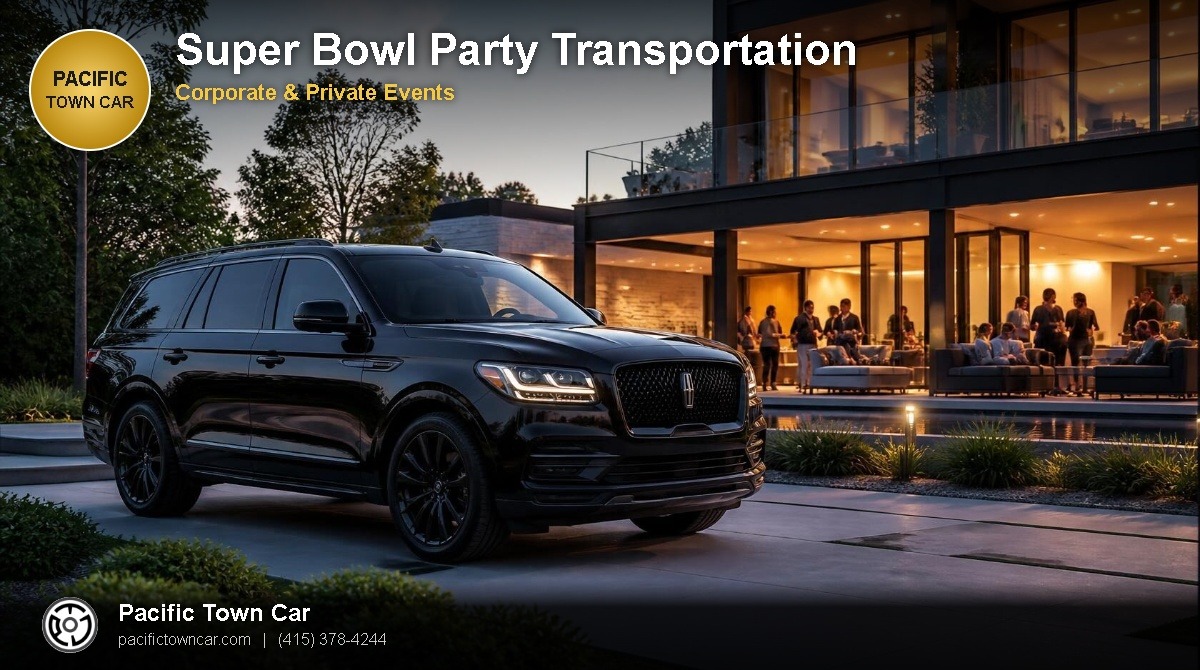
Few events on the American calendar generate the kind of energy, anticipation, and sheer logistical complexity as the Super Bowl. Whether you are a corporate hospitality director planning a client appreciation event in downtown Los Angeles or a private host welcoming forty guests into your Bay Area home, getting Super Bowl party transportation right is the single detail that determines whether your event feels effortless or chaotic. Great food, a perfect television setup, and a killer guest list can all be undone by a driveway full of double-parked cars, a valet line stretching around the block, or executives stuck circling a venue because there is nowhere to pull over. This guide walks through everything California hosts need to know about planning Super Bowl transportation for corporate and private events alike, from executive suite logistics to staggered shuttle schedules, and shows how a professional black-car fleet keeps the entire night running smoothly.
California hosts two of the most sophisticated event markets in the country, and Super Bowl Sunday pushes both to their limits. In Los Angeles, agencies and studios compete for premium suite space and rooftop lounges; in the Bay Area, tech companies and venture firms turn the game into a client-retention event disguised as a party. In both markets, transportation is no longer an afterthought — it is part of the guest experience, and it needs to be planned with the same rigor as the catering menu or the seating chart.
Why Super Bowl Party Transportation Deserves Its Own Planning Track
Most event planners build their timeline around the venue, the menu, and the entertainment, then treat transportation as a line item to handle “closer to the date.” For Super Bowl Sunday, that approach backfires. Game day traffic patterns are unpredictable, parking at premium venues evaporates hours before kickoff, and rideshare pricing surges dramatically during peak arrival and departure windows. A dedicated Super Bowl party transportation plan — built weeks in advance — protects your event from the three things that ruin a great party: late arrivals, parking gridlock, and guests who leave early because getting home feels like a hassle.
This is especially true for corporate events, where client perception is on the line from the moment a guest steps out of their car. A smooth, dignified arrival in a clean black SUV sets a tone of professionalism before anyone even reaches the door. For private hosts, the stakes are different but just as real — nobody wants forty friends’ cars lining a residential street, irritating neighbors and triggering parking tickets.
Corporate Super Bowl Event Planning in Los Angeles and the Bay Area
Corporate Super Bowl parties have evolved well beyond a conference room with a projector. Companies now treat the game as a premier client entertainment opportunity, often rivaling galas and product launches in scale and budget. A well-executed corporate Super Bowl event car service program is central to that experience, because client entertainment lives and dies on small details: being greeted at the curb, never waiting for a car, never worrying about where to park.
Client Entertainment and Executive Suites
In Los Angeles, entertainment and finance firms frequently host clients in stadium suites or at affiliated watch parties timed to kickoff. Discover Los Angeles highlights the city’s growing calendar of premium sports hospitality events, and venues across the region are increasingly built around this kind of experience. When a client is flying in for the weekend, their experience begins at the airport and continues through every transfer — hotel to suite, suite to afterparty, afterparty back to hotel. Coordinating Super Bowl executive transportation across these touchpoints requires a single point of contact, real-time flight tracking, and a fleet that can flex between a two-passenger sedan run and a six-passenger SUV transfer for a full client group.
Corporate Hospitality Events in the Bay Area
The Bay Area’s tech and venture community has its own flavor of Super Bowl hospitality — smaller, more intimate gatherings at private homes in the hills, boutique hotel lounges in SoMa, or waterfront venues with sweeping bay views. SF Travel regularly showcases the region’s premium event spaces, many of which sit in areas with notoriously limited parking. For a company hosting twenty to sixty guests, arranging a coordinated shuttle or black SUV rotation isn’t a luxury; it’s the only realistic way to move that many people through a dense urban venue without creating a logistical bottleneck at the front door.
This is where a company like Pacific Town Car becomes an extension of the event planning team rather than a simple vendor. With an all-black fleet of Cadillac Escalades, Lincoln Navigators, Mercedes S-Class sedans, and luxury SUVs, plus professional chauffeurs who understand the cadence of corporate events, the transportation becomes an invisible, reliable layer underneath the hospitality experience.
Private Home Party Hosting Logistics for Large Guest Lists
Hosting the Super Bowl at home is a California tradition, but once a guest list climbs past fifteen or twenty people, logistics shift dramatically. Street parking disappears, driveways fill up within the first hour, and latecomers end up parking blocks away and walking in during the second quarter. A private Super Bowl party shuttle solves this cleanly by consolidating arrivals into a handful of scheduled pickup runs rather than dozens of individual cars searching for parking.
Mapping the Guest List to a Transportation Plan
The first step for any private host is segmenting the guest list by neighborhood or proximity. Guests clustered in the same part of the city — say, a group coming from the same office building or the same side of town — can share a scheduled SUV pickup, cutting down on both the number of vehicles needed and the chaos of staggered individual arrivals. For larger parties, this might mean two or three pickup loops feeding into the party over a 90-minute arrival window, timed so the flow of guests matches the flow of food service rather than overwhelming the host at the door all at once.
Protecting the Neighborhood (and the Neighbors)
Nothing sours a Super Bowl party faster than an angry neighbor calling about blocked driveways. Private hosts in residential neighborhoods — whether in the Los Angeles hills or suburban Bay Area streets — benefit enormously from directing guests to a scheduled pickup rather than individual driving. It keeps the street clear, avoids parking citations for guests, and means nobody has to navigate home after a few drinks during the game.
Choosing the Right Venue: Private Venues, Hotel Ballrooms, and Rooftop Lounges
Venue choice shapes everything downstream, including transportation. Each option comes with its own access patterns, loading zones, and guest flow challenges.
Private Venues and Event Spaces
Private venues — converted warehouses, dedicated event spaces, or exclusive club rooms — offer control over the entire guest experience but often come with limited or nonexistent on-site parking. These venues are ideal candidates for a fully managed luxury SUV game day California shuttle program, where every guest is delivered directly to the door on a schedule, eliminating the parking question entirely.
Hotel Ballrooms
Hotel ballrooms simplify some logistics since the property typically has valet and loading zones already in place, but Super Bowl Sunday multiplies demand on those same resources. A property hosting multiple events that day will have its valet team stretched thin, so a corporate host arranging direct SUV drop-offs timed outside the valet’s busiest windows avoids guests getting stuck in a line that has nothing to do with their own event.
Rooftop Lounges
Rooftop lounges in downtown LA and San Francisco offer unbeatable atmosphere for a Super Bowl watch party, but they frequently sit atop buildings with restrictive loading zones, limited elevator capacity, and strict curb access rules during high-traffic events. Coordinating arrival times in small, scheduled waves — rather than one large rush right before kickoff — keeps both the lobby and the elevators moving smoothly.
Catering and Logistics Coordination: Where Transportation Fits In
Transportation doesn’t operate in a vacuum — it needs to be coordinated with catering delivery windows, AV setup crews, and staffing arrivals. A caterer bringing in a full staff an hour before guests arrive needs a clear loading zone; if that same zone is also where your guest shuttle plans to drop passengers, you have a conflict before the party even starts.
Smart hosts build a single master timeline that includes catering delivery, staff arrival, vendor load-in, and guest transportation side by side. This is particularly important for corporate events with multiple vendors converging on one venue. Assigning a specific arrival window to the transportation provider — separate from the catering load-in — prevents the kind of curb congestion that can delay an entire event by twenty or thirty minutes before a single guest has even walked in.
For hosts managing this complexity, working with a single transportation partner who can commit to specific time blocks, rather than piecing together several independent drivers, removes an entire category of risk. A coordinated fleet means one point of contact confirming pickup times, adjusting for weather or traffic, and communicating delays in real time rather than leaving the host to track down five different drivers separately.
Guest Transportation Planning: Staggered Pickup and Drop-off Strategy
The single most effective tactic for avoiding Super Bowl party chaos is staggering arrivals and departures. Every host, corporate or private, should build a transportation schedule in waves rather than assuming everyone will arrive — or leave — at the same moment.
Staggering Arrivals
Arrivals should be scheduled to spread guests across a 60 to 120 minute window leading up to kickoff, with VIPs or executives arriving slightly earlier to avoid being caught in the heaviest traffic of general guest arrival. Breaking the guest list into three or four pickup groups, each assigned a specific 15 to 20 minute arrival slot, keeps the venue entrance calm and allows host staff to greet guests properly instead of managing a crowd.
Avoiding Parking Chaos
Parking chaos is almost always a scheduling failure, not a capacity failure. Even venues with ample parking can feel overwhelmed if every guest arrives within the same ten-minute window. By assigning pickup times based on neighborhood clusters and staggering drop-offs at the venue, hosts avoid the classic Super Bowl Sunday bottleneck: a line of cars idling at the entrance while valet staff scrambles to keep up.
Managing the Departure Rush
Departure is often harder to manage than arrival because it is less predictable — some guests leave at the final whistle, others linger for an hour afterward. A strong transportation plan includes a flexible return shuttle or SUV rotation that runs continuously for two to three hours after the game ends, rather than a single mass pickup that forces everyone out the door at once.
How a Fleet of Black SUVs Supports Corporate Hospitality and Private Hosts Alike
Whether the event is a sixty-person corporate hospitality suite or a backyard watch party with thirty close friends, the underlying transportation challenge is the same: moving groups of people reliably, safely, and on a schedule that matches the rhythm of the event. This is precisely where an all-black fleet of professionally chauffeured SUVs and sedans earns its value.
Pacific Town Car operates across Los Angeles and the San Francisco Bay Area with a fleet built specifically for this kind of high-stakes, high-volume event day: Cadillac Escalades and Lincoln Navigators for larger groups and luggage-heavy airport transfers, Mercedes S-Class sedans for executive point-to-point travel, and additional luxury SUVs and sedans to flex capacity up or down as the guest list changes. Every vehicle is driven by a professional chauffeur trained to manage real-time schedule adjustments — critical on a day when traffic, weather, and game-time excitement can shift timing at a moment’s notice.
For corporate hosts, this means a dependable partner capable of running simultaneous airport transfers, hotel-to-venue shuttles, and executive point-to-point trips without losing track of a single passenger. For private hosts, it means a scheduled pickup service that eliminates the parking headache entirely, letting guests focus on the game instead of circling the block.
Building Your Super Bowl Transportation Timeline
A reliable way to approach Super Bowl party transportation planning is to work backward from kickoff. Start with the broadcast schedule, which the NFL publishes well in advance each season, and build your arrival windows to land guests at the venue 45 to 60 minutes before the game starts. From there:
- Confirm venue load-in times with caterers and AV vendors first, then schedule transportation arrivals around those windows.
- Segment your guest list into pickup groups by neighborhood or hotel location to minimize total vehicle trips.
- Assign VIPs and executives to earlier, dedicated pickup slots to avoid peak arrival traffic.
- Build a continuous return shuttle rotation for at least two hours after the final whistle.
- Designate one transportation point of contact who can communicate schedule changes to the entire fleet in real time.
This kind of structured planning transforms transportation from a reactive scramble into one of the most controlled parts of the entire event — which, on a day defined by unpredictable game-time emotion, is exactly the kind of reliability hosts need.
Corporate vs. Private: Matching the Service Level to the Event
Not every Super Bowl event needs the same transportation approach. Corporate events typically demand a higher level of white-glove service — individual executive pickups, real-time coordination with assistants, and flexibility for last-minute schedule changes tied to client travel. A corporate Super Bowl event car service program should be built around precision: confirmed pickup times, professional chauffeurs in appropriate attire, and vehicles that reflect the company’s brand standards.
Private hosts, by contrast, usually prioritize simplicity and group efficiency. A private Super Bowl party shuttle running a handful of scheduled loops between a few pickup points and the party is often all that’s needed, with the emphasis on cost-effective group transport rather than individual white-glove treatment. Understanding which category your event falls into — and being honest about guest expectations — helps determine the right size and structure of your transportation plan before you start booking vehicles.
Common Mistakes That Derail Super Bowl Party Transportation
Even experienced hosts make a handful of recurring mistakes when planning transportation for a high-traffic event like the Super Bowl:
- Booking too late. Premium vehicles and professional chauffeurs get reserved well in advance of major game days; waiting until the week of the event limits availability and options.
- Ignoring the return trip. Plenty of hosts plan a flawless arrival experience and completely forget to arrange departures, leaving guests to scramble for rideshares in a flooded, high-demand market.
- Underestimating guest count growth. Super Bowl parties have a way of growing past the original guest list. Building in a buffer of extra vehicle capacity avoids a last-minute scramble.
- Not communicating pickup details clearly. Guests need clear instructions — exact pickup times, locations, and vehicle descriptions — to avoid confusion and missed connections.
- Treating transportation as an afterthought. As outlined throughout this guide, transportation deserves the same planning attention as catering, venue, and entertainment.
Final Checklist for a Flawless Super Bowl Event
Before Super Bowl Sunday arrives, run through this final checklist:
- Guest list finalized and segmented into pickup groups by location.
- Transportation provider confirmed with vehicle count, types, and arrival windows locked in writing.
- Venue load-in schedule cross-checked against transportation arrival times to avoid curb conflicts.
- VIP and executive pickups assigned dedicated early slots.
- Return shuttle rotation scheduled for at least two hours post-game.
- Single point of contact designated for day-of schedule adjustments.
Handled this way, Super Bowl transportation becomes a quiet, reliable backbone rather than a source of stress — exactly what both corporate hosts protecting client relationships and private hosts protecting their neighborhood goodwill need on the biggest game day of the year.
Post-Game Wind-Down: Planning the Cleanup and Departure Transportation Window
Most transportation plans focus heavily on arrivals, but the hour or two after the final whistle is where a surprising number of Super Bowl events quietly unravel. Catering staff are breaking down stations, AV crews are packing up screens and sound equipment, and guests are leaving in unpredictable bursts rather than a single organized wave. Building a dedicated wind-down transportation window — separate from the arrival plan — keeps this final stretch of the night as controlled as the first.
Coordinating Cleanup Crews and Vendor Departures
Caterers and AV vendors typically need their own loading window to break down equipment, and that window often overlaps with the exact time guests are requesting pickups. Private venues and rooftop lounges in particular tend to have a single functional loading zone, so a host who hasn’t planned for this overlap can end up with a cleanup truck blocking the same curb space a guest SUV is trying to use. Flagging the vendor breakdown schedule to your transportation provider in advance lets chauffeurs plan pickup sequencing around it rather than discovering the conflict in real time.
Safe Rides Home After the Final Whistle
Super Bowl parties, corporate or private, almost always involve alcohol, and the designated driver conversation is one every responsible host should have before kickoff, not after the game ends. A pre-scheduled return shuttle removes the need for that conversation entirely — guests simply board a car on a rotation rather than deciding whether they, or a friend, are fit to drive home. For corporate hosts, this is also a liability consideration: arranging professional transportation for every guest, win or lose, protects both the company and the individual.
Handling the Stragglers
Every party has a core group that lingers well past the final score, rehashing plays and finishing the last of the food. A flexible wind-down rotation — rather than a single hard-cutoff pickup — accommodates this naturally, with a chauffeur or two staying on call for an extended window so the last guests leaving at midnight get the same reliable experience as the first guests who left right after the game.
Frequently Asked Questions About Super Bowl Party Transportation
How far in advance should I book Super Bowl transportation?
For both Los Angeles and the Bay Area, booking three to four weeks ahead is a safe target, and six weeks is better for larger corporate groups. Premium SUVs and experienced chauffeurs are a limited resource on the biggest game day of the year, and demand climbs sharply in the final two weeks before kickoff.
How many vehicles does a typical event need?
It depends heavily on guest clustering. A private party of thirty guests living across a wide area might need three to four SUVs running staggered loops, while the same guest count arriving from two or three nearby hotels might need only two vehicles. Mapping guest locations before requesting a quote keeps the fleet size accurate rather than oversized or undersized.
What happens if the game runs long or goes to overtime?
A professional transportation partner builds flexibility into the return shuttle rotation specifically for this scenario, extending the pickup window rather than ending service at a fixed time. This is one of the clearest advantages of working with a dedicated provider rather than relying on rideshare availability, which becomes unpredictable precisely when a game runs late and citywide demand spikes.
Can the same fleet handle both airport transfers and local event shuttling?
Yes, and for corporate events with out-of-town clients, this is often the single biggest advantage of working with one provider. A fleet capable of handling airport pickups, hotel transfers, and venue shuttling under one coordinated schedule — the kind of program highlighted by hospitality resources like SF Travel for Bay Area visitors — means a client’s entire weekend runs through a single point of contact rather than multiple disconnected bookings.
Is black SUV service only for large groups, or does it work for smaller gatherings too?
A single executive sedan transfer or a two-vehicle shuttle for a dozen friends benefits from the same reliability as a sixty-guest corporate program. The scale of the fleet simply flexes to match the guest count, which is why both a boutique Bay Area gathering and a full-stadium-suite corporate event can be booked through the same provider without compromising on service quality.
Book Pacific Town Car for Your Super Bowl Party Transportation
From executive suite transfers in downtown Los Angeles to a coordinated shuttle rotation for a private watch party in the Bay Area hills, Pacific Town Car provides the all-black fleet of Cadillac Escalades, Lincoln Navigators, Mercedes S-Class sedans, and luxury SUVs — paired with professional chauffeurs — that make Super Bowl party transportation effortless for corporate hosts and private party planners alike. Secure your vehicles early, before the biggest game day of the year books out every premium car service in California. Call (415) 378-4244 or visit pacifictowncar.com today to reserve your Super Bowl fleet and give your guests an arrival experience as memorable as the game itself.