
If you have ever typed a search query, swiped on a smartphone, or binge-watched a show on a streaming app, you have already been touched by what happened in a quiet stretch of the San Francisco Bay Area. A Silicon Valley tour is one of the few travel experiences that lets you walk the actual ground where the modern world was invented — from a garage behind a Palo Alto bungalow to the glass ring of a trillion-dollar company’s headquarters. For tech enthusiasts, students, and curious travelers alike, this is bucket-list sightseeing, and doing it right means knowing exactly where to go, what you can (and can’t) photograph, and how to string it all together into one unforgettable day.
This guide covers the landmarks worth your time, the startup history that gives them meaning, a realistic day itinerary, etiquette tips for photographing private corporate campuses, and why so many visitors are now trading rideshare apps and rental cars for a private, chauffeur-driven black SUV when they explore the region.
Why Silicon Valley Deserves a Spot on Your Travel Itinerary
Silicon Valley is not a single city — it’s a loose constellation of towns stretching roughly from San Francisco down through San Jose, including Palo Alto, Mountain View, Cupertino, and Menlo Park. What unites them is seventy-plus years of concentrated innovation: the first commercial silicon transistor companies, the first personal computers, the first search engines, and the first smartphones that actually felt magical to use. Unlike most “tech cities,” the Valley’s landmarks aren’t skyscrapers — they’re low, unassuming office parks, university quads, and, in one famous case, a one-car garage.
That’s part of what makes Silicon Valley sightseeing so interesting. You’re not gawking at architecture for architecture’s sake; you’re standing where specific decisions and specific people changed how billions of us live. A thoughtfully planned Silicon Valley tour threads together the museums that explain this history, the campuses where it’s still being written, and the quiet residential streets where it quite literally started in someone’s backyard.
The Computer History Museum: Start Here to Understand Everything Else
Any serious tech history tour Bay Area itinerary should begin at the Computer History Museum in Mountain View. Think of it as the Smithsonian of computing — a sprawling collection that traces the arc from room-sized mainframes and punch cards to the Apple I, early Pixar renders, and the servers that powered the first search engines. The centerpiece exhibit, “Revolution: The First 2000 Years of Computing,” is dense enough to occupy a dedicated history buff for hours, but it’s organized well enough that casual visitors can breeze through the highlights in 60–90 minutes.
A Computer History Museum tour is the single best investment of time on this entire itinerary because it gives context to everything you’ll see afterward. Once you’ve seen the actual machines that Stanford engineers and garage tinkerers built by hand, driving past the gleaming campuses of their corporate descendants hits very differently. Check the Computer History Museum’s site for current hours and any timed-entry requirements before you go, since exhibits and tour availability do shift seasonally.
Stanford University: The Academic Engine Behind the Valley
No Silicon Valley tour is complete without time on the Stanford University campus. Stanford isn’t just a pretty quad with Spanish Mission-style arches and a towering Hoover Tower — it is arguably the single most important institution in the Valley’s creation story. Professor Frederick Terman famously encouraged his students, including a pair named Bill Hewlett and David Packard, to start companies locally instead of moving east, planting the cultural seed that grew into the entire regional ecosystem.
Walking the Stanford University campus today, you’ll pass the engineering quad, the Dish hiking trail with its sweeping Valley views, and the Stanford Research Park next door, which has hosted early offices for companies ranging from Hewlett-Packard to Facebook in its first year. Allow at least 45 minutes to an hour just to see the central quad, Memorial Church, and Hoover Tower — longer if you want to add a short walk toward the Dish for photos overlooking the Valley floor.
Why Academic History Matters to Tech Tourists
If you only think of Silicon Valley in terms of billion-dollar brands, Stanford reframes the story as an academic and almost accidental one. The region’s rise wasn’t centrally planned by any government or corporation; it emerged from a research university that encouraged its graduates to stay local, build things, and take risks. That cultural DNA — risk tolerance, close university-industry ties, and a dense local talent pool — is still the engine behind every startup founded in the area today.
The HP Garage: The Literal Birthplace of Silicon Valley
A few miles from campus, at 367 Addison Avenue in Palo Alto, sits the most symbolically important address in American technology: the HP Garage. In 1939, Bill Hewlett and David Packard built their first product, an audio oscillator, in this one-car garage with $538 in starting capital. California designated the site a historic landmark, and a plaque out front officially calls it “the birthplace of Silicon Valley.”
It is a private residence today, so you can’t go inside, but it’s absolutely worth the short detour for a photo of the plaque and the garage itself from the sidewalk. There’s something almost disorienting about standing in front of such an ordinary suburban garage, knowing that the entire multi-trillion-dollar regional economy traces back to it. Many first-time visitors on a Silicon Valley tour say this unassuming stop is the most memorable moment of the day — more moving, in its way, than any corporate campus. Just remember it’s a residential street: keep voices low, stay on the public sidewalk, and don’t linger directly in front of the driveway.
Apple Park Visitor Center: The Spaceship Up Close
From the birthplace of the Valley to one of its most futuristic chapters: the Apple Park Visitor Center in Cupertino is open to the public and sits directly across the street from Apple’s famous ring-shaped headquarters, nicknamed “the spaceship.” The Visitor Center has an Apple Store, a café, a scale architectural model of the campus, and a rooftop terrace with views of the ring building and its surrounding orchard.
While the main headquarters building itself is not open to visitors, the Apple Park Visitor Center gives you the closest legitimate look at the campus you’ll get, plus a genuinely well-designed augmented-reality model that lets you see the building’s roofline and solar array from above on your phone screen. It’s a quick stop — 20 to 30 minutes is usually plenty — but it’s a must for anyone tracing the modern era of the Valley’s tech history tour Bay Area circuit.
Googleplex: Viewing a Campus Built for Exploration (From the Outside)
Next on most itineraries is a drive past the Googleplex in Mountain View. Unlike Apple’s Visitor Center, Google’s campus doesn’t have an official public visitor attraction, but the surrounding public streets and the Shoreline Park area nearby offer good vantage points for photos of the colorful bikes, outdoor sculptures (including the famous Android statues near the visitor lobby, when accessible to the public), and the general texture of the campus. Many guided Silicon Valley sightseeing routes pair this stop with a short drive along nearby Shoreline Boulevard, which offers a pleasant, low-key way to see the scale of the campus without trespassing on private property.
This is a good moment to mention something important: these are working corporate campuses with real security, real employees, and real privacy expectations. The next section covers exactly how to handle photography near them respectfully.
Startup History and Culture: What You’re Really Looking At
Part of what makes a tech history tour Bay Area experience so rewarding is understanding the culture behind the landmarks, not just the buildings themselves. A few threads worth knowing before you go:
- The “garage startup” myth has real roots here. Hewlett-Packard, Apple, and Google all trace origin stories to garages, dorm rooms, or rented spaces rather than corporate offices — a pattern that shaped the Valley’s self-image as a place where anyone with an idea and a willingness to tinker can build something enormous.
- Venture capital grew up alongside the engineers. Sand Hill Road in Menlo Park, just minutes from Stanford, became the world’s density capital for venture capital firms precisely because it sat next to both the university talent pipeline and the semiconductor and computing companies that needed funding.
- Failure is treated differently here than almost anywhere else. The regional culture famously tolerates — even expects — failed startups as a normal, even valuable, part of a founder’s résumé, a mindset that’s distinct from most other business cultures worldwide.
- The talent pool is self-reinforcing. Engineers who leave one Valley company frequently start or join another nearby, which is part of why so many iconic companies sit within a 20-mile radius of each other.
Understanding this context transforms a simple drive-by of office parks into something closer to a walking history lesson — which is exactly the experience most visitors are hoping for when they book a Silicon Valley tour in the first place.
A Recommended Day Itinerary for Your Private Silicon Valley Tour
Here’s a realistic, well-paced itinerary for a full day of Silicon Valley sightseeing, assuming a mid-morning start from San Francisco or a South Bay hotel:
- 9:30 a.m. – Computer History Museum, Mountain View. Start with context. Budget 75–90 minutes.
- 11:15 a.m. – Googleplex drive-by and Shoreline area photos. A quick 20-minute stop.
- 11:45 a.m. – Stanford University campus. Walk the quad, Memorial Church, and Hoover Tower; grab lunch nearby in downtown Palo Alto. Budget 90 minutes to two hours including lunch.
- 1:45 p.m. – HP Garage, Palo Alto. A brief, respectful photo stop of 10–15 minutes.
- 2:15 p.m. – Apple Park Visitor Center, Cupertino. Browse the Visitor Center, model, and rooftop terrace. Budget 30–45 minutes.
- 3:15 p.m. – Optional add-ons: a drive through downtown Mountain View or Palo Alto’s University Avenue for tech-adjacent shopping and coffee, or a scenic stop near the Dish trail for Valley overlook photos.
That itinerary covers roughly 40–50 miles of driving across several towns in one day — manageable, but logistically fiddly if you’re trying to navigate unfamiliar freeway interchanges, find parking near Stanford, or figure out where exactly you’re allowed to stop near a corporate campus. This is precisely the kind of multi-stop day where a private driver earns their keep.
Photo-Stop Etiquette Near Corporate Campuses
Because so much of this tour runs past active corporate property and private residences, a little etiquette goes a long way:
- Stay on public sidewalks and streets. Never step onto landscaped corporate grounds, private driveways, or posted “employees only” areas, even for a better camera angle.
- Treat the HP Garage like the residential street it is. Keep your visit brief, quiet, and respectful of the people who actually live there.
- Don’t block driveways, bike lanes, or traffic. Campuses like Apple Park and the Googleplex see constant employee and delivery traffic; a parked car blocking a lane creates real problems fast.
- Follow posted security instructions immediately. Private security staff at tech campuses are generally polite but firm — if asked to move along, do so without argument.
- Be mindful of drone restrictions. Several campuses in the area, including Apple Park, sit under flight restrictions; don’t assume recreational drone photography is permitted.
This is another area where local knowledge pays off. A chauffeur who tours this route regularly already knows which curbs allow a quick stop, where the best unobstructed photo angles are, and how to time arrivals to avoid shift-change traffic around campuses — details that save you from circling the block looking for parking or accidentally wandering somewhere you shouldn’t.
Why a Private Black SUV Beats Self-Driving or Rideshare for This Kind of Day
You could technically string this itinerary together with a rental car or a string of rideshare bookings, but anyone who has tried it will tell you it’s more friction than it’s worth. Here’s why a private tour with a professional chauffeur is the better call for Silicon Valley sightseeing specifically:
- No parking hunts. Stanford’s visitor lots fill up, Palo Alto’s downtown streets are metered and tight, and Cupertino’s Apple Park Visitor Center lot gets busy on weekends. A chauffeur handles all of it while you walk straight to the entrance.
- No re-booking rides between stops. Rideshare apps are fine for a single point-to-point trip, but a six-stop day means six separate bookings, six waits for a driver to arrive, and six opportunities for a car that doesn’t show up on time.
- Local routing knowledge. A driver who regularly covers this corridor knows the fastest way between Mountain View, Palo Alto, and Cupertino at different times of day, and which streets near the HP Garage or Googleplex are actually suited to a quick stop.
- You can actually enjoy the ride. Self-driving means someone in your group is staring at a GPS instead of the scenery. A chauffeured SUV means everyone gets to look up.
- Comfort for a long day. A full Silicon Valley tour easily runs six to eight hours door to door. An all-black Cadillac Escalade or Lincoln Navigator with proper legroom and climate control makes a meaningful difference by hour five.
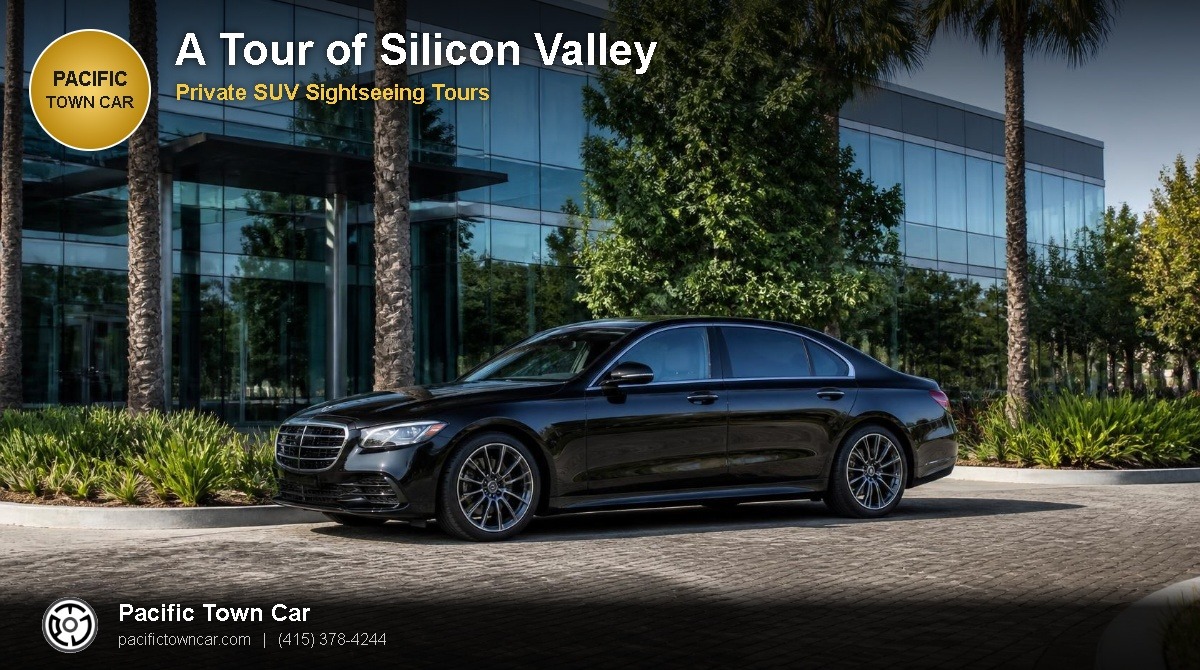
This is exactly the kind of day Pacific Town Car is built for. The company runs an all-black fleet — Cadillac Escalades, Lincoln Navigators, Mercedes S-Class sedans, and other luxury SUVs — with professional chauffeurs who are comfortable handling multi-stop sightseeing itineraries across both Los Angeles and the greater San Francisco Bay Area. Instead of juggling parking apps and rideshare wait times, you book one vehicle for the whole day and let someone else handle the logistics while you focus on the landmarks.
Tips for Making the Most of Your Silicon Valley Tour
A few practical notes to tighten up your plan:
- Book the Computer History Museum first thing. Mornings tend to be quieter, and starting with context makes every later stop more meaningful.
- Weekdays are busier near corporate campuses, weekends are quieter. If photography is your priority, a Saturday morning around Apple Park or the Googleplex tends to be calmer than a Tuesday at lunch.
- Pack for a full day outdoors. Between Stanford’s quad, the HP Garage sidewalk, and the Apple Park rooftop terrace, you’ll be outside more than you expect, even if you’re mostly riding between stops.
- Build in a flexible buffer. Traffic on 101 and 280 through the Peninsula can be unpredictable; a private driver can adjust the order of stops on the fly if something’s running long.
Combine those tips with a knowledgeable local chauffeur, and a day that could easily become a stressful scavenger hunt turns into a relaxed, well-paced tour you’ll actually remember for the landmarks — not the parking.
Where to Eat Near the Landmarks: Dining and Cafes Worth a Stop
A full day of Silicon Valley sightseeing covers a lot of ground, and the towns along the route happen to have some of the best casual dining in the Bay Area. Building a meal or a coffee break into your itinerary isn’t just practical — it’s part of the experience, since many of these spots sit just steps from the landmarks themselves.
- University Avenue, Palo Alto. This walkable strip near the Stanford campus is lined with everything from casual sandwich shops to upscale California cuisine, and it sits just minutes from the HP Garage stop on your itinerary. It’s an easy, low-effort lunch break between Stanford and the garage.
- Castro Street, Mountain View. A few minutes from the Computer History Museum and the Googleplex, this tree-lined downtown strip has a dense cluster of cafes and restaurants that make a natural coffee stop either before or after your museum visit.
- Cupertino’s Main Street district. Near Apple Park, this newer retail and dining corridor is a convenient spot to grab a coffee before or after the Visitor Center, especially if you want to avoid the lines at the Visitor Center’s own café on a busy weekend.
- Menlo Park’s Santa Cruz Avenue. If your route includes a pass through Menlo Park near Sand Hill Road, this downtown strip offers a quieter, less touristy alternative to Palo Alto with plenty of coffee shops suited to a quick break.
None of these require reservations for a casual stop, which matters on a tightly scheduled sightseeing day — your chauffeur can simply pull up, wait, and get you back on schedule without the hassle of finding parking twice in one afternoon.
Best Time of Year and Time of Day to Visit for Fewer Crowds and Better Photos
Timing matters more than most first-time visitors expect. The Bay Area’s dry, mild climate means there’s no single “bad season” for a Silicon Valley tour, but a few patterns are worth planning around.
Spring (March through May) and early fall (September and October) tend to offer the clearest skies and the most comfortable walking temperatures, without the marine fog that can blanket the Peninsula on summer mornings. If photography is a priority — especially for shots of Apple Park’s glass exterior or the Stanford quad’s sandstone arches — late morning to early afternoon light tends to be the most flattering, once the fog has burned off but before the harsh midday glare sets in.
For crowds, weekday mornings beat weekend afternoons almost everywhere on this route. The Computer History Museum and Apple Park Visitor Center both see heavier weekend foot traffic from families and tourists, while Stanford’s campus is busiest when students are moving between classes on weekday afternoons. A Tuesday or Wednesday starting around 9:30 a.m., as outlined in the itinerary above, tends to produce the quietest version of nearly every stop on this list — fewer people in your photos, shorter waits at the Visitor Center counter, and easier parking near the HP Garage and Stanford. Visitors coming from Cupertino or the South Bay side can often flip the itinerary and start at Apple Park instead, which has the same early-morning advantage.
Frequently Asked Questions About Touring Silicon Valley
Can you go inside the Googleplex or Apple’s headquarters building?
No. Both are active, private corporate campuses. Apple’s Visitor Center is open to the public, but the ring-shaped headquarters itself is not. Google does not operate a public visitor attraction at the Googleplex, so your view is limited to what’s visible from public streets and nearby parks like Shoreline.
Is the HP Garage open to the public?
No, it’s a private residence. Visitors can only view it from the public sidewalk, which is why a brief, respectful photo stop is the standard approach.
How much walking is involved in a typical Silicon Valley tour?
Less than you might think. Most of the day is spent being driven between stops, with short walking segments inside the Computer History Museum, around the Stanford quad, and through the Apple Park Visitor Center. Comfortable shoes are still a good idea given the Stanford and museum stops.
Do I need to book tickets in advance for the Computer History Museum or Apple Park?
It’s worth checking each site’s own page before you go, since timed-entry requirements and hours can change seasonally. Generally, the Apple Park Visitor Center does not require advance tickets, while the Computer History Museum may have specific exhibit or guided-tour booking windows depending on the season.
Can a Silicon Valley tour be combined with San Francisco sightseeing in one day?
It’s possible but ambitious. Most visitors who want to do both comfortably split the trip across two days, using a private chauffeur for the Silicon Valley leg so the drive time between San Francisco and the Peninsula doesn’t eat into either day’s sightseeing.
Book Your Private Silicon Valley Tour with Pacific Town Car
From the garage where Hewlett and Packard got started to the glass ring where Apple designs its next generation of products, a well-planned Silicon Valley tour is one of the most rewarding ways to spend a day in the Bay Area — if you have the right vehicle and the right driver handling the details. Pacific Town Car offers private, chauffeured sightseeing tours throughout the Bay Area and Los Angeles in an all-black fleet of Cadillac Escalades, Lincoln Navigators, Mercedes S-Class sedans, and other luxury SUVs, with professional chauffeurs who know exactly how to move between the Computer History Museum, Stanford, the HP Garage, Apple Park, and the Googleplex without missing a beat.
Ready to see Silicon Valley the easy way? Call (415) 378-4244 or visit pacifictowncar.com to book your private Silicon Valley tour today.